
Rugby Betting Guide: Odds & Strategies 2026
 Available in US

Learn how to bet on rugby with our comprehensive guide. Discover rugby betting markets, odds explained, winning strategies, top tournaments, and expert tips for Rugby Union and League betting.
Table of Contents
Introduction
Rugby has spent decades building its reputation as one of the most physically demanding team sports on the planet, and somewhere along the way, it also became one of the most compelling sports to wager on. What started as a niche pursuit for bettors in the Southern Hemisphere and British Isles has transformed into a global betting market. The 2023 Rugby World Cup in France drew over 600,000 traveling fans and billions of television viewers, demonstrating that the sport's appeal extends far beyond its traditional strongholds. By 2026, rugby betting has matured into a sophisticated market with depth that rivals football and basketball in terms of available options and strategic complexity.
The appeal of betting on rugby lies in its unique combination of physicality, strategy, and unpredictability. Unlike sports where individual brilliance can dominate outcomes, rugby is profoundly team-dependent. A single missed tackle can shift momentum, a substitution at the right moment can change the game's tempo entirely, and weather conditions can turn a high-scoring shootout into a grinding defensive battle. For bettors willing to do their homework, these variables create opportunities that more efficient markets simply cannot offer.
This guide exists because most rugby betting content online falls into one of two categories: thin promotional pages designed to funnel you toward a sportsbook, or superficial overviews that barely scratch the surface. Neither serves the bettor who wants to actually understand what they are doing. Whether you have never placed a rugby bet in your life or you are looking to refine an existing approach, the following pages will give you the foundation to make informed decisions. We will cover everything from the fundamental differences between Rugby Union and Rugby League to advanced market analysis, from reading odds to avoiding the mistakes that drain bankrolls.
Rugby is not a forgiving sport for those who bet casually. The margins between winning and losing are often razor-thin, and the sport rewards those who pay attention to detail. Team news drops late, conditions change rapidly, and the betting markets adjust accordingly. But for those willing to invest the time, rugby offers something increasingly rare in sports betting: genuine value opportunities that persist because the market remains less efficient than its more popular counterparts. The bookmakers are good, but they are not infallible, and this guide will help you identify where their lines might be exploitable.
Understanding Rugby for Betting Purposes

Rugby Union vs Rugby League: Key Differences
The first question any aspiring rugby bettor must answer is deceptively simple: which rugby are we talking about? Rugby Union and Rugby League share a common ancestor and superficial similarities, but they are fundamentally different sports with distinct betting implications. Treating them interchangeably is a reliable way to lose money.
Rugby Union is the older and more globally widespread code, played with 15 players per side. The game features contested scrums, lineouts, rucks, and mauls, creating a complex tactical environment where possession can change hands frequently. Matches consist of two 40-minute halves, and the scoring system awards five points for a try, two for a conversion, three for a penalty kick, and three for a drop goal. International Rugby Union is governed by World Rugby, and the sport's flagship competitions include the Six Nations Championship, The Rugby Championship, and the Rugby World Cup.
Rugby League emerged from a split in 1895 and evolved into a faster, more streamlined game with 13 players per side. The tackle count system, which gives teams six tackles to advance the ball before surrendering possession, creates a more predictable rhythm. Tries are worth four points, conversions two, and penalty goals two. The game tends to produce higher scores and more consistent offensive outcomes than Union. Rugby League's strongholds are northern England, Australia, and New Zealand, with the NRL representing the sport's premier club competition.
For betting purposes, these differences matter enormously. Rugby Union's contested possession phases and varied scoring methods produce more volatile scorelines and make handicap betting trickier to predict. League's structured play and consistent tackle counts create more predictable point totals, making over/under markets somewhat more reliable. Understanding which code you are betting on, and how its mechanics influence outcomes, is the non-negotiable starting point for any serious rugby bettor.
How Points Are Scored in Rugby
Scoring in rugby is more varied than in most major sports, and this variety creates betting opportunities that do not exist elsewhere. In Rugby Union, a try is scored when a player grounds the ball in the opponent's in-goal area, worth five points. The subsequent conversion kick adds two points if successful. Penalty kicks, awarded for various infractions, are worth three points. Drop goals, struck during open play, also score three points and often prove decisive in tight matches.
Rugby League simplifies this structure slightly but maintains the multi-pathway scoring model. Tries are worth four points, conversions two, and penalty goals two. Drop goals count for just one point, reflecting their diminished tactical importance in the League game. The difference in try values between the codes affects how bettors should think about total points markets and handicaps. A two-try swing in Union represents a ten-point shift; in League, it is only eight points.
The implications for betting extend beyond simple arithmetic. In Union, teams trailing by seven points remain very much in contention because a converted try levels the score. In League, a six-point deficit can be erased with a single try and conversion. These dynamics influence how matches unfold in their closing stages and should inform your approach to live betting and closing line analysis. Bettors who understand scoring structures can identify situations where the market undervalues comeback potential or overestimates the security of a lead.
Rugby Betting Markets Explained

Match Result (Moneyline)
The match result market is the most straightforward way to wager on rugby. You pick which team will win the match. In most rugby competitions, draws are possible, so the market typically offers three options: home win, away win, or draw. International matches and knockout tournament games may go to extra time to produce a winner, which affects how the market settles.
The simplicity of match result betting makes it appealing to beginners, but simplicity does not mean it lacks strategic depth. The key to profitable moneyline betting lies in identifying value, which means finding situations where the implied probability embedded in the odds underestimates a team's actual chances of winning. This requires moving beyond gut feelings and developing a systematic approach to assessing team strength, form, and situational factors.
When considering match result bets, context matters enormously. Is this a pool stage game where one team has already qualified and might rest players? Is it a rivalry match where historical patterns override current form? Are there injury concerns that the market has not fully priced in? Moneyline betting rewards patience and selectivity. The best bettors pass on matches where they lack a clear edge and strike decisively when opportunities arise.
Handicap Betting (Point Spread)
Handicap betting levels the playing field between mismatched opponents by giving the underdog a virtual head start. If New Zealand is playing Italy, the bookmakers might set New Zealand at -25.5 points and Italy at +25.5 points. For a bet on New Zealand to win, they must win by 26 or more points. A bet on Italy wins if Italy keeps the margin within 25 points or wins outright.
The half-point handicaps eliminate the possibility of a push, where the bet would be refunded if the margin lands exactly on the spread. Some bookmakers offer whole-number handicaps with push rules, while others use Asian handicap formats that split stakes between two lines. Understanding the specific rules your sportsbook applies is essential before placing handicap bets.
Handicap betting is where serious rugby bettors often find the most consistent value. The moneyline on a heavy favorite may offer odds of -500 or worse, requiring enormous risk for minimal reward. The handicap market forces you to predict not just the winner but the margin, which is considerably harder for bookmakers to price accurately. Factors like team motivation, game management in late stages, and benching of starters when outcomes are secure can all influence whether a team covers the spread.
Over/Under (Total Points)
Over/under betting focuses on the combined score of both teams rather than the winner. The bookmaker sets a line, say 45.5 points, and you bet whether the actual total will be higher or lower. This market appeals to bettors who have strong views on game tempo and scoring conditions but are uncertain about the winner.
Total points in rugby are influenced by numerous factors beyond team quality. Weather conditions rank among the most significant. Rain makes the ball slippery and handling errors more frequent, typically depressing scoring. Wind affects kicking accuracy and game management decisions. Playing surface conditions, particularly late in a season or during winter months, can similarly impact scoring rates.
Team styles also drive totals. Some teams play expansive, try-scoring rugby while others grind out victories through forward dominance and penalty accumulation. When an expansive team meets a defensive side, predicting the total becomes genuinely challenging. Historical head-to-head data can illuminate these matchups, though sample sizes in international rugby are often small enough that statistical significance remains elusive.
Try Scorer Markets
Try scorer betting asks you to predict which individual player will score. The first try scorer market offers attractive odds because the range of possible outcomes is wide, but it also carries substantial risk. Injuries, tactical changes, and simple variance mean that even strong candidates frequently fail to deliver.
Positional analysis provides the foundation for try scorer betting. Wingers and outside centers score the majority of tries in professional rugby because their positions place them in space when attacking moves come off. Fullbacks also score frequently, particularly those who join the line as an extra attacker. Forwards can score, especially powerful number eights and flankers, but their try-scoring opportunities are less predictable.
Anytime try scorer is a more forgiving version. Your selected player can score at any point during the match, not just first. The odds are lower to reflect the increased probability, but the market still offers opportunities for bettors with strong player-level analysis. Multi-bet strategies using anytime try scorers have become popular, though they concentrate risk significantly.
Other Popular Markets
Winning margin betting asks you to predict not just the winner but how many points will separate the teams. Markets typically offer bands such as Team A by 1-12 points, Team A by 13-24 points, or Team A by 25 or more. This market rewards bettors who can accurately model game flow and late-game scenarios.
Half-time/full-time betting combines two predictions: which team leads at halftime and which team wins the match. The market offers nine possible outcomes when draws are included, ranging from Home/Home to Away/Away with various combinations in between. Correctly predicting both results is harder than predicting either individually, and the bookmakers reward this difficulty with more generous pricing.
Futures and outright betting involves wagering on outcomes determined over a season or tournament rather than a single match. Outright winner markets ask you to predict the tournament champion before or during the competition. Timing is everything in futures betting. Early bets capture the best prices on genuine contenders before the market corrects, but they also carry the risk of backing teams that subsequently hit obstacles.
How Rugby Betting Odds Work
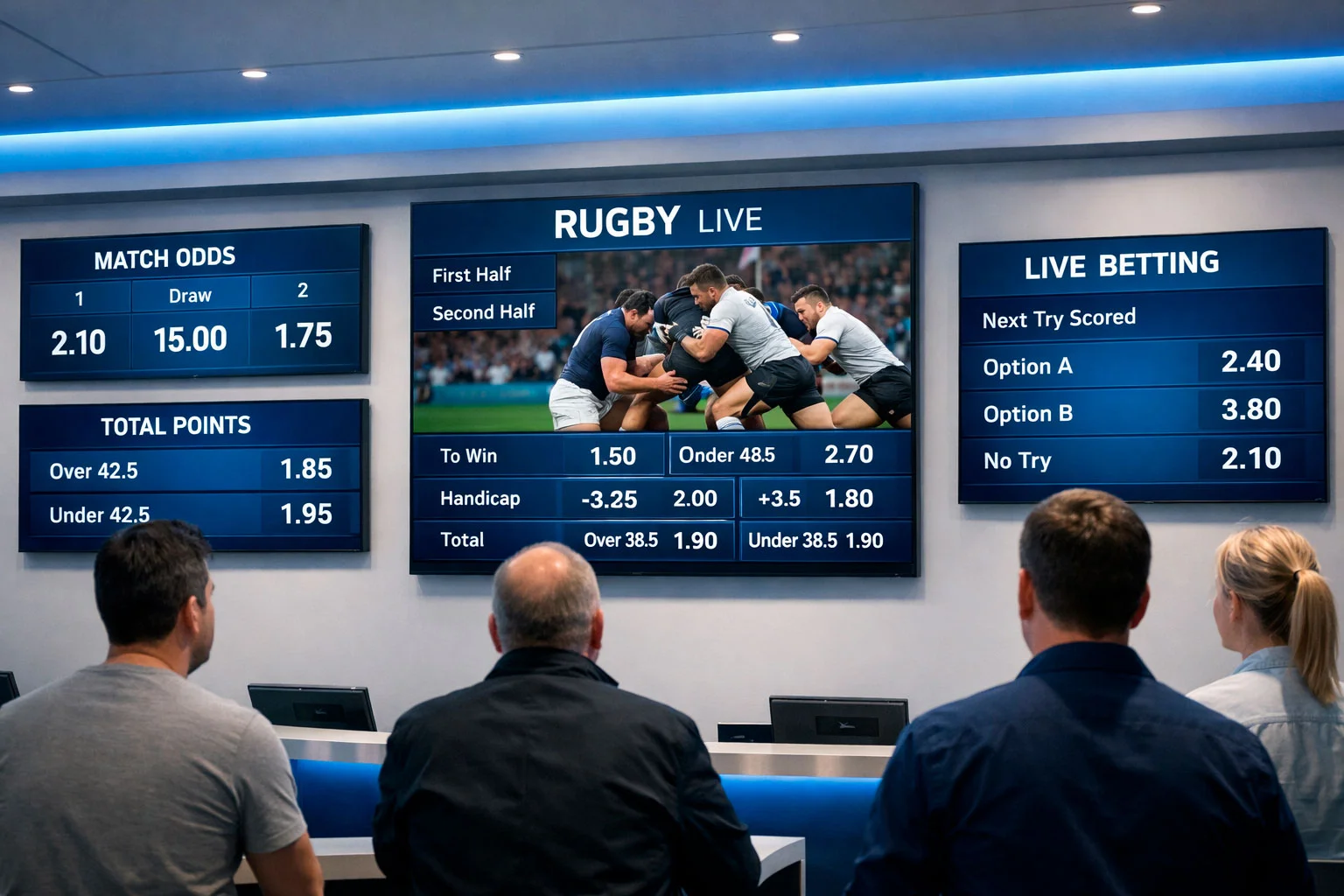
Understanding Odds Formats
Rugby betting odds appear in three main formats depending on your location and preferred sportsbook. Decimal odds, popular in Europe, Australia, and New Zealand, express the total return on a winning bet including your original stake. Odds of 2.50 mean a successful ten-unit bet returns 25 units total, comprising 15 units of profit plus your original ten-unit stake. The calculation is simple multiplication: stake times odds equals total return.
Fractional odds, traditional in the United Kingdom and Ireland, show profit relative to stake. Odds of 3/2 mean you win three units for every two units staked. A successful ten-unit bet at 3/2 returns 25 units, identical to the decimal 2.50 example. Converting between formats becomes second nature with practice, but initially, many bettors find decimal odds more intuitive for calculating potential returns.
American odds use positive and negative numbers to indicate underdogs and favorites. Positive odds show how much profit a 100-unit bet would generate. Negative odds show how much you need to stake to win 100 units. American odds are most common on North American sportsbooks and may initially confuse bettors accustomed to other formats.
Converting Odds to Implied Probability
Every set of odds implies a probability that the bookmaker assigns to that outcome occurring. Understanding implied probability allows bettors to compare their own assessments against market pricing and identify potential value. The conversion is straightforward: divide one by the decimal odds, then multiply by 100 to express as a percentage.
Decimal odds of 2.00 imply a 50% probability. Odds of 4.00 imply 25% probability. Odds of 1.50 imply 66.67% probability. When you believe a team has a 60% chance of winning but the market offers odds implying only 50% probability, you have identified a potential value bet. The market is underestimating that team's chances relative to your assessment.
Bookmaker margins complicate this analysis because the implied probabilities of all outcomes in a market sum to more than 100%. This overround represents the house edge. Comparing odds across multiple sportsbooks helps identify which offers the best value on specific outcomes and reduces the impact of overround on your long-term returns.
Calculating Potential Returns
Calculating returns before placing a bet ensures you understand exactly what you stand to gain or lose. For decimal odds, multiply your stake by the odds to get total return, then subtract your stake to isolate profit. A 50-unit bet at odds of 1.80 returns 90 units total, representing 40 units of profit.
For accumulator bets combining multiple selections, multiply the odds of each selection together to get combined odds, then apply the same calculation. Three selections at 1.50, 2.00, and 1.80 combine to 5.40. A 20-unit accumulator at combined odds of 5.40 returns 108 units total, or 88 units profit. The appeal of accumulators lies in these multiplied returns, though the probability of winning decreases with each added selection.
Most online sportsbooks display potential returns automatically when you enter your stake, but understanding the underlying math helps you evaluate bets more critically. It also allows you to calculate returns when comparing options across different platforms.
Major Rugby Tournaments for Betting

Six Nations Championship
The Six Nations Championship brings together England, France, Ireland, Wales, Scotland, and Italy each February and March in Europe's premier international rugby tournament. The round-robin format guarantees 15 matches over five weekends, with each nation playing the other five once. The combination of fierce historical rivalries and genuinely competitive matches makes the Six Nations a favorite among rugby bettors.
From a betting perspective, the Six Nations offers several advantages. Home advantage is pronounced, with host nations winning approximately 60% of matches historically. This creates predictable patterns that bettors can exploit, particularly when oddsmakers undervalue traveling teams or overcompensate for home advantage in specific matchups. The Grand Slam and Triple Crown provide additional betting opportunities beyond match and tournament outcomes.
The tournament's timing creates unique analytical challenges. It occurs during the latter stages of the domestic club season, meaning player fitness and injury status fluctuate based on club commitments. Weather also plays a significant role, with February matches often affected by winter conditions that favor forward-oriented teams over those relying on expansive backline play.
The Rugby Championship
The Rugby Championship pits the Southern Hemisphere's powerhouses against each other: New Zealand, South Africa, Australia, and Argentina. Contested annually from August to October, the tournament features home and away matches between all participants, producing 12 fixtures of generally high quality.
New Zealand's historical dominance has traditionally made outright markets less competitive, but recent years have seen South Africa and Argentina narrow the gap significantly. The 2023 Rugby World Cup final between New Zealand and South Africa underscored how closely matched the top Southern Hemisphere nations have become. This competitive balance translates to betting markets where value can be found on multiple teams.
Long-haul travel affects performance in The Rugby Championship more than any other major tournament. Teams traveling from Argentina to New Zealand face journeys exceeding 20 hours and time zone shifts of 15 hours or more. Historical data suggests teams perform worse in the first away match of a tour, offering bettors a systematic angle to incorporate into their analysis.
Rugby World Cup
The Rugby World Cup, held every four years, represents the pinnacle of international rugby and the largest betting market in the sport. The tournament runs over approximately six weeks, progressing from pool stages through knockout rounds to crown a world champion. The 2027 edition will be hosted by Australia and feature an expanded format of 24 teams, up from the 20 teams that competed in 2023.
World Cup betting markets open months or even years before the tournament begins, with outright odds fluctuating based on team performance in intervening competitions. Early betting captures value on teams the market has not yet properly assessed, while late betting offers reduced uncertainty as team selections and form become clearer. Both approaches have merit depending on your analytical framework.
The pool stage and knockout stage require different betting strategies. Pool matches feature significant mismatches alongside competitive fixtures, creating varied opportunities across match result, handicap, and totals markets. Once knockout rounds begin, the intensity increases dramatically, and underdogs frequently outperform expectations.
Domestic Club Competitions
Beyond internationals, domestic club competitions offer year-round betting opportunities with deeper markets and more frequent fixtures. The English Premiership, French Top 14, United Rugby Championship, and Super Rugby Pacific represent the highest-profile leagues. Each has distinct characteristics that influence betting approaches.
The English Premiership runs from September to June, featuring salary cap constraints that create competitive balance across the league. French Top 14 clubs operate with larger budgets and attract international star players, producing higher-scoring matches on average. The United Rugby Championship integrates teams from vastly different rugby cultures, creating interesting tactical mismatches. Super Rugby Pacific combines Australian and New Zealand franchises with Pacific Island teams.
Domestic fixtures provide larger sample sizes for statistical analysis than international windows. Team performance trends, home and away splits, and head-to-head records become more meaningful with 20-plus matches per season rather than 10-12 internationals per year. Bettors who specialize in a single competition can develop informational advantages over generalist oddsmakers.
Rugby Betting Strategies and Tips

Research Fundamentals
Successful rugby betting begins with systematic research rather than intuition or team loyalty. The minimum viable preparation for any match includes reviewing recent form for both teams, checking injury and suspension lists, understanding the significance of the fixture in tournament or league context, and assessing conditions. Skipping any of these steps creates blind spots that bookmakers will exploit.
Team news in rugby drops later than in many sports, often just 24-48 hours before kickoff for international matches and sometimes less for club fixtures. Following official team accounts, reputable rugby journalists, and club communications ensures you receive this information as quickly as possible. Line movements following team announcements can be sharp and swift, rewarding those positioned to act immediately.
Historical data provides context but must be interpreted carefully. Head-to-head records matter less than recent form because squad turnover in rugby is substantial. A rivalry's historical results from five years ago reflect different players and often different coaching approaches. More valuable is understanding how specific tactical matchups have played out recently.
Value Betting Principles
Value betting forms the foundation of profitable sports wagering regardless of sport. A value bet exists when your assessed probability of an outcome exceeds the implied probability embedded in the odds. If you believe a team has a 55% chance of winning but the odds imply only 45% probability, you have found value even if the team loses that particular match.
Identifying value requires developing your own probability assessments independent of market prices. This is harder than it sounds because our brains naturally anchor to available information, including the odds themselves. One approach is to make your predictions before checking prices, then compare your assessments to the market. Persistent discrepancies between your predictions and market odds, when your predictions prove accurate over time, indicate a genuine edge.
Value betting demands patience and discipline because short-term results include substantial variance. A bet with a 10% edge will still lose frequently. Over hundreds of bets, that edge compounds into profit, but over tens of bets, losing streaks are inevitable. Bettors who abandon sound processes after brief downturns never realize the long-term benefits of value-oriented approaches.
Managing Your Bankroll
Bankroll management protects against the variance inherent in sports betting and ensures you survive losing streaks to realize long-term edges. The first principle is simple: never bet money you cannot afford to lose. Betting should come from a dedicated fund separate from essential living expenses.
Conservative bankroll strategies recommend wagering 1-3% of your total bankroll on any single bet. More aggressive approaches allow up to 5%, but exceeding this level increases the risk of ruin during inevitable downturns. Adjusting stake size based on confidence level, with larger bets on higher-conviction plays, is reasonable but requires honest self-assessment of your edge.
Tracking your bets in a spreadsheet or dedicated application enables performance analysis and identifies strengths and weaknesses in your approach. Recording the match, bet type, odds, stake, and result for every wager creates a dataset for review. Over time, patterns emerge: perhaps you excel at handicap betting but struggle with totals, or your Six Nations predictions outperform your club rugby analysis.
Weather and Conditions Analysis
Weather affects rugby more significantly than most sports, and incorporating conditions into your analysis can provide meaningful edges. Rain makes handling difficult, increasing turnover rates and typically reducing scoring. Wet conditions favor teams with strong kicking games and physical forward packs over those relying on expansive passing and backline moves.
Wind impacts the sport in multiple ways. Kicking for territory becomes harder into the wind, affecting game management and field position battles. Goal kicking percentages decline in strong winds, particularly for kicks from wide angles or long distances. Teams with the wind advantage in a half often build leads that prove difficult to overcome when conditions reverse.
Altitude affects matches in certain venues, most notably in South Africa where several Test venues sit over 1,500 meters above sea level. The thinner air reduces kicking accuracy for some players and increases the physical demands on teams not acclimated to the conditions. Teams traveling to altitude for the first time often underperform.
Getting Started with Rugby Betting
Choosing a Sportsbook
Selecting the right sportsbook establishes the foundation for your rugby betting activities. The factors that matter most include market variety, odds competitiveness, payment options, mobile functionality, and regulatory status. Different bettors prioritize these factors differently based on their needs and preferences.
Market variety determines which bets you can place. Some sportsbooks offer extensive rugby coverage with dozens of markets per match, while others provide only basic match result and handicap options. If your strategy involves prop bets, try scorer markets, or in-play wagering, verify that your chosen platform supports these options for the competitions you intend to bet on.
Odds competitiveness directly affects your long-term profitability. Even small differences in odds compound significantly over hundreds of bets. Maintaining accounts with multiple sportsbooks allows you to shop for the best available price on each selection, a practice called line shopping that serious bettors consider essential. Regulatory status matters because licensed sportsbooks provide consumer protections including dispute resolution mechanisms.
Placing Your First Rugby Bet
The mechanics of placing a rugby bet are straightforward once you have selected a sportsbook and funded your account. Navigate to the rugby section, find the competition and match you want to bet on, and browse the available markets. Click on the odds for your chosen selection to add it to your bet slip, enter your stake, review the potential return, and confirm the bet.
Before confirming, verify every detail. Check that you have selected the correct match, market, and outcome. Confirm the odds have not changed since you began building your bet slip. Ensure your stake is appropriate for your bankroll and confidence level. These verification steps take seconds but prevent costly errors.
Starting with straightforward bets while you learn the sport's nuances makes sense for new rugby bettors. Match result and handicap markets on high-profile matches provide enough complexity to develop skills without overwhelming you with variables. As your understanding grows, expand into try scorer markets, totals, and multi-bet strategies.
Live Betting Considerations
In-play betting allows wagers to be placed after a match has begun, with odds updating in real time based on score, time elapsed, and game flow. The market offers the same bet types as pre-match betting plus some live-specific options like next scoring team or next try scorer.
Live betting rewards quick thinking and pattern recognition. Momentum shifts in rugby are visible to attentive observers before they manifest in the scoreline. A team winning the collision battle, dominating territory, or generating repeated attacking opportunities is likely to score soon, even if they have not yet. Bettors who can identify these patterns faster than the bookmakers adjust their lines can find fleeting value.
The risks of live betting deserve acknowledgment. The pace of decision-making increases dramatically, and the potential for impulsive, poorly considered wagers rises accordingly. Cash-out options can be useful tools but also encourage premature profit-taking or loss-chasing behavior. Disciplined live bettors establish clear criteria for entry before matches begin.
Common Rugby Betting Mistakes to Avoid
Betting Without Sufficient Research
The most common mistake among rugby bettors is placing wagers without adequate preparation. This manifests in various forms: betting based on team names and reputations rather than current form, ignoring team news until after placing bets, failing to consider venue and conditions, or relying on surface-level narratives promoted by media coverage.
Research does not require hours of work for every match, but it does require consistent application of a sensible process. Spending fifteen minutes reviewing form, team news, and conditions before each bet prevents the majority of avoidable errors. The bettors who consistently profit approach every wager with the same disciplined preparation.
Building research habits takes time but compounds into significant advantages. Create a checklist of factors to review before any bet and work through it systematically. Over weeks and months, this process becomes automatic and efficient, allowing you to cover more matches without sacrificing analytical rigor.
Chasing Losses and Emotional Betting
Chasing losses destroys more betting bankrolls than any other behavioral pattern. The psychology is understandable: after losing, bettors want to recover their money quickly, leading to larger stakes, lower-quality selections, or both. This response almost always makes the situation worse, converting manageable losses into catastrophic ones.
Emotional betting extends beyond loss-chasing to include betting on favorite teams regardless of value, overreacting to recent results, and staking irrationally based on excitement or frustration. These patterns share a common root: allowing feelings to override analysis. The solution requires self-awareness and pre-commitment to rules that constrain behavior during emotional moments.
Establishing cooling-off periods after losses helps break the chase cycle. If you lose a bet, step away from betting for a defined period, whether an hour, a day, or until the next match week. This creates space for emotional equilibrium to return before making further decisions.
Ignoring Line Movement and Market Signals
Odds move in response to betting activity and new information, and ignoring these movements means missing valuable signals about market sentiment. When a line moves significantly without obvious news, professional bettors are likely driving the change based on analysis you have not considered. This does not mean you should blindly follow market moves, but you should understand why they occur.
Steam moves, where odds shift rapidly across multiple sportsbooks simultaneously, often indicate sharp action from sophisticated betting operations. Reverse line movement, where odds move opposite to the direction public money appears to be flowing, suggests bookmakers respect the minority position. Learning to read these patterns adds a dimension to your analysis.
Betting stale lines represents one of the most straightforward edges available. If team news breaks and you can bet before the market corrects, you capture value that disappears quickly. Following the right information sources and acting decisively when opportunities arise separates successful bettors from those who consistently find themselves on the wrong side of market moves.
Overcomplicating Your Approach
Complexity feels sophisticated but often reduces betting profitability rather than improving it. Elaborate accumulator strategies, exotic multi-leg parlays, and convoluted staking systems frequently underperform simple approaches applied consistently. The human tendency to seek novelty and excitement leads bettors toward complicated methods that generate entertainment at the expense of returns.
The most profitable bettors typically focus on a narrow range of markets where they have genuine expertise and apply straightforward selection criteria. They might specialize in Six Nations handicaps or Super Rugby totals, developing deep knowledge within a defined domain rather than spreading attention across dozens of competitions and bet types.
Periodically auditing your betting activity helps identify unnecessary complexity. Review your results by market type, competition, and stake level. Ruthlessly eliminating what does not work and doubling down on what does is more valuable than adding new strategies to your repertoire.
Conclusion
Rugby betting rewards those who approach it with respect for the sport's complexity and commitment to disciplined analysis. The game's unique characteristics, from its varied scoring methods to its dependence on physical confrontation and field position, create a betting landscape unlike any other sport. Bookmakers have become increasingly sophisticated in pricing rugby markets, but inefficiencies persist for bettors willing to specialize and work harder than their competition.
The foundation of profitable rugby betting rests on understanding what you are actually betting on. The differences between Rugby Union and Rugby League matter. The specific scoring rules and their implications for different markets matter. The tournament context, team news, and conditions all matter. Bettors who treat these factors as peripheral details rather than core analytical inputs consistently underperform those who build comprehensive models incorporating all available information.
Market selection deserves more attention than most bettors give it. Not all bet types offer equivalent value opportunities. Some markets, like certain prop bets with high overround, are essentially entertainment products where the house edge makes long-term profit extremely difficult. Others, particularly handicaps and totals in less-followed competitions, occasionally present genuine value for those with relevant expertise.
Behavioral discipline ultimately separates long-term winners from the majority who lose. Research processes, bankroll management, and emotional control are not exciting topics, but they determine outcomes more reliably than any single analytical breakthrough. The bettors who profit year after year have typically mastered these fundamentals rather than discovering secret strategies the rest of the market has missed. The good news is that these skills are learnable. The challenge is that learning them requires consistent effort that most are unwilling to provide.
For those beginning their rugby betting journey in 2026, start small, track everything, and prioritize learning over immediate profit. The goal in your first year should be understanding how the markets work, discovering where your analytical strengths lie, and developing habits that position you for long-term success. Approach rugby betting as a craft to be developed rather than a puzzle to be solved, and the results will eventually follow.
FAQ
What is the difference between Rugby Union and Rugby League for betting purposes?
Rugby Union and Rugby League differ in ways that significantly impact betting strategy. Union fields 15 players per side versus League's 13, and the scoring systems diverge with Union awarding five points per try compared to League's four points. Union features contested possession through scrums, lineouts, rucks, and mauls, creating more unpredictable game flow and scoring patterns. League uses a tackle count system that produces more structured, predictable offensive sequences. For bettors, Union matches typically have more variable scoring and larger result margins, making handicap markets trickier to predict accurately. League's consistent structure leads to more predictable total points, making over/under markets somewhat more analyzable. Successful bettors develop separate analytical approaches for each code rather than applying a unified method to both.
How does handicap betting work in rugby?
Handicap betting levels competition between unevenly matched teams by applying a virtual points adjustment to the final score. When you see odds like New Zealand -15.5 versus Ireland +15.5, the handicap gives Ireland a 15.5-point head start for betting purposes. If you bet New Zealand -15.5 and they win by 16 or more points, your bet wins. If Ireland loses by 15 or fewer points or wins outright, bets on Ireland +15.5 win. The half-point handicaps eliminate ties. Some bookmakers offer whole-number handicaps where exact margin results in stake refunds. Handicap betting allows bettors to find value on favorites without accepting prohibitive moneyline odds, or to back underdogs while requiring them only to keep the match competitive rather than win outright. Understanding how specific teams perform against the spread is essential for profitable handicap betting.
What are the most popular rugby betting markets?
The most popular rugby betting markets span from straightforward match predictions to specific player performances. Match result betting remains the most accessible market, requiring bettors simply to pick the winner. Handicap betting attracts significant volume because it creates meaningful odds on mismatched fixtures. Over/under total points markets allow betting on combined scoring without predicting the winner. Try scorer markets, including first try scorer and anytime try scorer, offer higher odds for player-specific predictions. Winning margin markets ask bettors to predict the precise points difference between teams. Half-time/full-time bets combine two predictions for elevated potential returns. For tournaments, futures markets on outright winners, pool winners, and top try scorers generate substantial interest. In-play betting has grown rapidly, allowing wagers throughout matches. Each market type suits different analytical approaches and risk tolerances.
