
Weather & Rugby Betting: Impact on Odds
 Available in US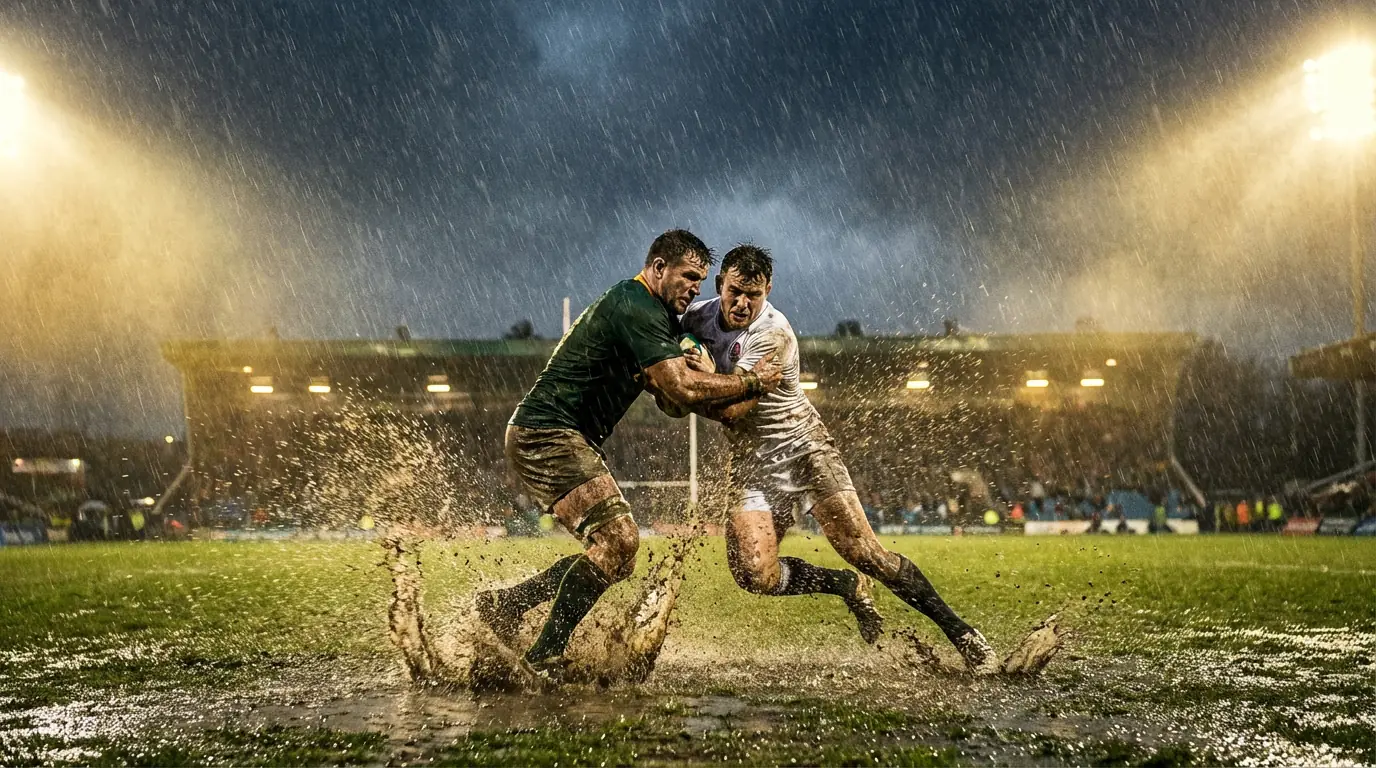

Rugby is played outdoors, in winter, on grass that turns to mud when it rains. This is not a design flaw — it is the sport’s identity. But what makes rugby romantically brutal also makes it analytically interesting for bettors, because weather conditions affect match outcomes in measurable, predictable, and frequently underpriced ways.
Most bettors check the weather forecast before deciding whether to bring an umbrella to the stadium. Sharp bettors check it before deciding whether to take the over or the under. The difference in approach is worth real money over a season, and the data to support it is freely available to anyone willing to spend five minutes on a weather app the morning of a match.
Impact of Rain on Rugby Matches
Rain reduces scoring. This is not a hypothesis — it is one of the most robust statistical relationships in rugby analytics. Across multiple professional competitions, matches played in persistent rain produce 8-15 fewer combined points on average compared to matches played in dry conditions. The effect is not subtle, and it shows up consistently whether you measure it in the Premiership, the URC, Super Rugby, or international fixtures.
The mechanisms are straightforward. A wet ball is harder to handle, leading to more knock-ons and turnovers that interrupt attacking flow. Scrums become more frequent as a result of those errors, and scrums consume time without producing points. Kicking for territory becomes the dominant tactic because running the ball wide on a slippery surface invites handling mistakes in dangerous positions. Lineout throws — already one of the most difficult technical skills in rugby — become less reliable, reducing a primary platform for attacking play.
Conversion and penalty kick accuracy also drops in the rain, though less dramatically than many bettors assume. Professional kickers practise in all conditions, and modern ball technology has improved grip significantly. The reduction is real but modest — perhaps 5-8% lower conversion rates in heavy rain compared to dry conditions. Where kicking is more affected is in distance: long-range penalty attempts and restarts suffer more than close-range conversions because the wet ball travels slightly differently through the air.
For bettors, the practical implication is clear. When rain is forecast for a rugby match, the under on total points becomes more attractive. But the value depends on whether the bookmaker has already adjusted the line. If the total has moved from 45.5 to 39.5 because of the weather forecast, the adjustment may already be priced in. The edge exists when the bookmaker either has not adjusted at all (rare for major fixtures but common for lower-profile games) or has under-adjusted relative to historical rain data.
Wind: The Invisible Handicap
Wind affects rugby differently from rain, and its impact is harder to quantify because it depends on direction, consistency, and the specific ground’s exposure to the elements.
A strong crosswind makes goalkicking unreliable from wide positions, which changes how teams approach the red zone. Rather than kicking a penalty from a tight angle, a team may opt for a lineout drive or scrum, seeking a try instead. This tactical shift sometimes increases try-scoring (because teams take more attacking risks) while decreasing penalty goals, with the net effect on total points being ambiguous. In some conditions, wind actually pushes totals slightly higher because the additional tries more than compensate for missed kicks.
A headwind or tailwind has a more predictable effect. Teams playing into a strong wind struggle to gain territory with their kicks, which compresses the match into one half of the pitch. The team with the wind at their backs dominates field position and typically scores more in that period. This creates an interesting half-time betting dynamic: if you know which team has the wind advantage in the first half, you can anticipate a lopsided half-time score that might not reflect the full-match outcome.
Coastal and exposed grounds — Thomond Park in Limerick, the Stoop in London, Forsyth Barr Stadium’s open-air predecessor in Dunedin — are notoriously windy. Inland grounds surrounded by stands, like the Aviva Stadium or Twickenham, offer much more shelter. Knowing which venues are wind-prone is a basic but valuable piece of contextual knowledge for any rugby bettor.
Cold and Pitch Conditions
Temperature itself has a smaller direct impact on scoring than rain or wind, but it influences player behaviour and, more importantly, pitch conditions. Cold, firm pitches provide better footing and a truer ball bounce, which can actually favour attacking rugby. Some of the highest-scoring matches in the Premiership and Pro14/URC have occurred on crisp, dry winter days where the ground is hard and fast.
The problem arises when cold combines with moisture. Frost followed by a midday thaw creates a slippery surface that mimics the handling difficulties of rain without the visual cue of falling water. Bookmakers and bettors who check the forecast and see “no rain” might miss the fact that the pitch is effectively as treacherous as a wet surface due to overnight frost melt. Checking temperature trends over the 24 hours before kickoff, not just the match-time forecast, gives a more accurate picture of actual pitch conditions.
Heavy, waterlogged pitches are the most extreme condition in rugby. A pitch that has absorbed several days of rain — common in mid-winter fixtures in the UK, Ireland, and France — slows everything down. Players tire faster because running through mud is physically more demanding, ball movement is restricted, and the game compresses into a forward-dominated arm wrestle. These conditions produce the lowest-scoring matches of the season and are almost always an under play, often by a significant margin beyond what the bookmaker has adjusted.
Artificial pitches, increasingly common at club level, neutralise all weather effects on the playing surface itself. The ball still gets wet in rain, but the footing remains consistent regardless of conditions. Matches on artificial surfaces tend to produce more consistent scoring patterns, reducing the variance that weather introduces on natural grass. If a team plays on an artificial pitch and the forecast shows rain, the total-points impact of that rain is smaller than it would be on a saturated grass field.
Building a Weather-Adjusted Betting Model
You do not need a degree in meteorology to incorporate weather into your rugby betting. A simple framework that categorises conditions into three buckets — dry, light rain or moderate wind, and heavy rain or strong wind — and applies historical scoring adjustments to each bucket is enough to gain an edge over bettors who ignore weather entirely.
Start by collecting the average total points scored in each competition you bet on, broken down by weather conditions. Most match reports from professional competitions note the weather at kickoff, and historical data going back several seasons is available through rugby statistics databases. Calculate the average combined score for dry matches, light-adverse matches, and heavy-adverse matches in each competition. The differences will be clear and consistent.
Next, before each match, check the forecast and assign the fixture to one of your three buckets. Compare the bookmaker’s total-points line against your bucket’s historical average. If the bookmaker’s line is significantly above your historical average for that weather bucket, the under is the value side. If the line is below your average, the over may be worth considering.
This approach is deliberately simple, and it will not capture every nuance — a swirling crosswind at a coastal ground is not the same as steady rain at a sheltered stadium. But the simplicity is the point. Weather is one variable among many, and overcomplicating your model introduces false precision. A three-bucket system that you apply consistently will outperform a sophisticated model that you apply inconsistently because it takes too long to run.
The Forecast Timing Advantage
Weather forecasts become significantly more accurate within 24-48 hours of an event. A five-day forecast might predict sunny skies for Saturday, only for a rain system to develop on Thursday that changes the picture entirely. Bettors who place their totals bets early in the week, before the weather is clear, are gambling on conditions as well as on teams.
The optimal timing for weather-sensitive bets is Friday evening or Saturday morning, when forecasts for the day’s fixtures are highly reliable. By this point, the bookmaker may have already adjusted the line based on the same forecast, but the adjustment is not always sufficient — particularly for lower-profile matches that receive less bookmaker attention. A URC fixture between two mid-table teams on a Saturday afternoon might see its total adjusted by only a point or two for rain, when the historical data suggests a 5-8 point reduction is warranted.
This window also coincides with team announcements, which provide additional context. A team that selects a heavy, forward-oriented XV on a rainy day is signalling their intent to play territory rugby — further supporting the under. A team that keeps their attacking backline intact despite poor weather might be overconfident or might have a specific game plan that the bookmaker has not fully accounted for. Either way, the combination of weather data and team selection provides a richer analytical picture than either factor alone.
Mud, Glory, and the Market
Rugby was born in English rain, and the sport has never fully shed its affection for terrible conditions. Fans love a mud-soaked forward battle as much as they love a sunny day of free-flowing tries. Bookmakers, however, do not have the luxury of romance — they need to set accurate lines regardless of the weather.
The bettor who checks the forecast, reviews historical scoring data in similar conditions, and times their bet to maximise informational advantage is doing something remarkably simple. They are reading the weather and asking whether the line agrees. Most of the time it does. But often enough to matter, it does not — and those are the days when the sky gives back more than it takes.
