
Rugby Betting Odds Explained: Calculate Formats & Value
 Available in US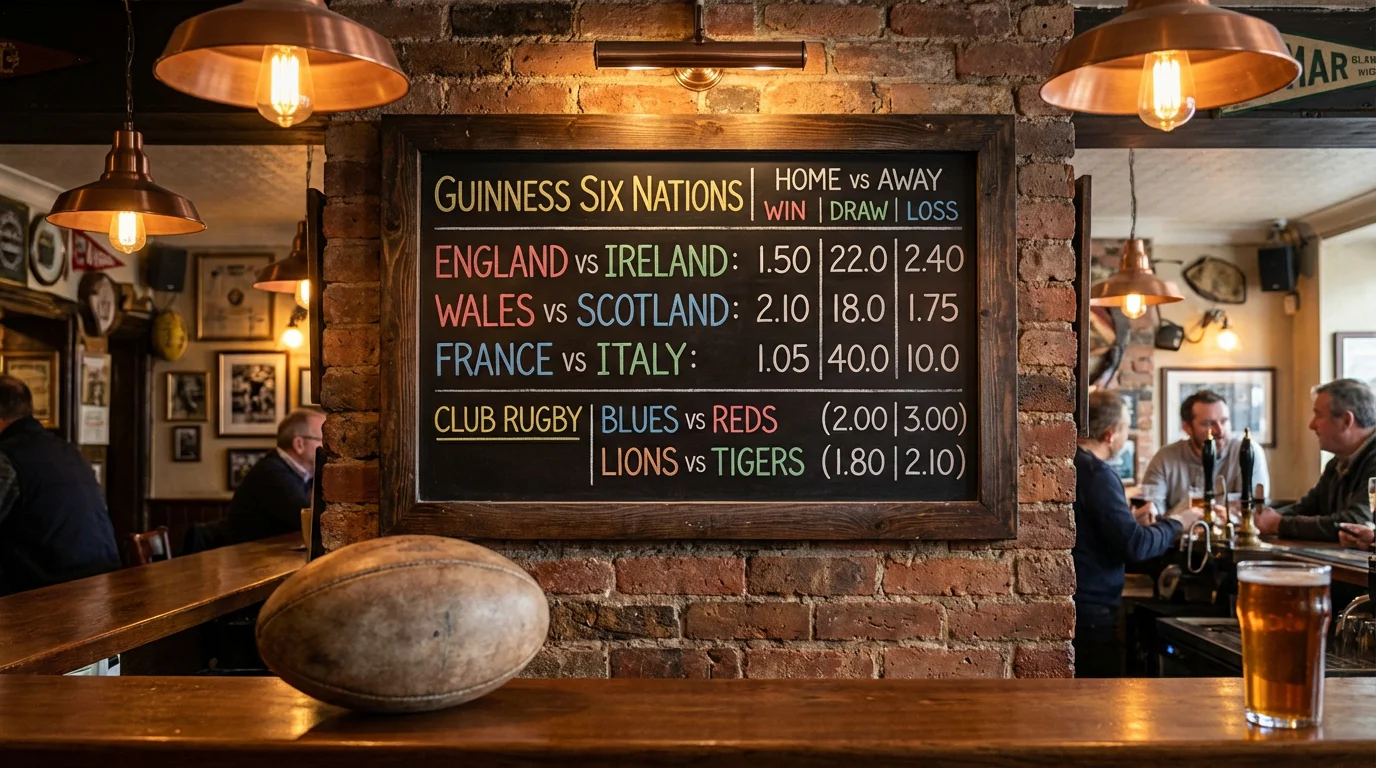

Odds are the language of betting. If you cannot read them fluently, you are placing wagers without understanding what you are being paid — or what the bookmaker thinks will happen. The good news is that all three major odds formats express the same underlying information. The bad news is that the betting industry, in its infinite wisdom, decided that one format was not enough, so you will encounter all three depending on where you bet and which sportsbook you use.
This guide covers decimal, fractional, and American odds with rugby-specific examples, including how to convert between formats and how to calculate implied probability — the single most important concept in profitable betting.
Decimal Odds: The Global Betting Standard
Decimal odds are used across Europe, Australia, and most online sportsbooks. They express the total return you receive for every unit staked, including your original stake. If the odds are 2.50 and you bet 10 units, your total return is 25 (10 x 2.50), of which 15 is profit and 10 is your returned stake.
The beauty of decimal odds is their simplicity. Higher numbers mean bigger payouts and lower implied probability. An outcome priced at 1.50 is considered more likely than one at 3.00. There is no ambiguity, no mental arithmetic beyond basic multiplication, and no difference in how favourites and underdogs are displayed — they sit on the same continuous scale.
In rugby betting, you will see decimal odds applied across every market. A Six Nations match might show Ireland at 1.35, the draw at 26.00, and England at 3.40. At a glance, you know Ireland are heavy favourites, England are clear underdogs, and the draw is a remote possibility. No further interpretation needed.
To calculate your potential profit in decimal format, the formula is straightforward: (Odds x Stake) – Stake = Profit. For a 20-unit bet on England at 3.40, the total return is 68 units, and the profit is 48 units. If Ireland win, you lose your 20-unit stake and nothing more.
Fractional Odds: The British Tradition
Fractional odds remain common in the UK and Ireland, particularly at traditional bookmakers and in horse racing circles. They express profit relative to stake. Odds of 5/2 (spoken as “five to two”) mean you win 5 units of profit for every 2 units staked. Your total return on a 2-unit bet would be 7 (5 profit plus 2 stake returned).
The format takes some getting used to. Odds of 1/4 mean you risk 4 to win 1, indicating a strong favourite. Odds of 7/1 mean you win 7 for every 1 staked — a long shot. When the two numbers are equal (1/1, known as “evens”), your profit exactly matches your stake.
Rugby examples help ground the concept. If Wales are 2/1 to beat Scotland, a 10-unit bet returns 30 (20 profit plus 10 stake). If Scotland are 6/4, a 20-unit bet returns 50 (30 profit plus 20 stake). The same match with a draw at 20/1 means a 5-unit bet returns 105 (100 profit plus 5 stake) — an unlikely but lucrative outcome.
Fractional odds become cumbersome with complex numbers. Seeing 11/8 or 100/30 requires mental division that decimal odds handle instantly. Many UK sportsbooks now default to decimal format on their websites and apps, though fractional odds persist in shop windows, televised racing, and newspaper betting columns. If you are comfortable with decimals, there is no compelling reason to prefer fractions — but being able to read both is essential if you bet in British markets.
American Odds: Plus and Minus
American odds, also called moneyline odds, are standard in the United States and on US-facing sportsbooks. They use a baseline of 100 units and split into two formats depending on whether the outcome is favoured or not.
A negative number (e.g., -150) tells you how much you need to stake to win 100 units of profit. At -150, you bet 150 to win 100, for a total return of 250. The larger the negative number, the stronger the favourite. Odds of -500 mean you need to risk 500 to win 100 — a heavy favourite where the bookmaker considers the outcome very likely.
A positive number (e.g., +200) tells you how much profit you win on a 100-unit stake. At +200, a 100-unit bet returns 300 total (200 profit plus 100 stake). The larger the positive number, the longer the shot. Odds of +1500 mean a 100-unit bet would yield 1,500 profit — an outcome the bookmaker considers unlikely.
In a rugby context, you might see New Zealand at -350 and Argentina at +275 for a Rugby Championship Test. The All Blacks are strong favourites (you risk 350 to win 100), while Argentina are underdogs offering nearly three-to-one on your money. If the match also lists a draw at +2200, you know the bookmaker assigns that outcome roughly a 4-5% chance.
American odds can feel counterintuitive at first. The minus sign and the plus sign represent fundamentally different questions (how much to risk versus how much you win), which makes quick mental comparison harder than with decimal odds. However, US-based bettors grow accustomed to the format rapidly, and many apps allow you to toggle between formats with one tap.
Converting Between Formats
Being able to convert odds between formats is essential when comparing prices across sportsbooks that use different defaults. The conversions are mechanical:
- Decimal to fractional: Subtract 1 from the decimal odds, then express as a fraction. Decimal 3.50 becomes 2.5/1, simplified to 5/2.
- Decimal to American: If decimal odds are 2.00 or above, the formula is (Decimal – 1) x 100 = positive American odds. Decimal 3.50 becomes +250. If decimal odds are below 2.00, the formula is -100 / (Decimal – 1) = negative American odds. Decimal 1.50 becomes -200.
- Fractional to decimal: Divide the fraction and add 1. Fractional 5/2 = 2.5 + 1 = 3.50.
- American to decimal: For positive American, divide by 100 and add 1. +250 becomes 3.50. For negative American, divide 100 by the absolute value and add 1. -200 becomes 1.50.
You do not need to memorise these formulas. Any odds converter tool will handle it instantly. What matters is understanding that 3.50 decimal, 5/2 fractional, and +250 American all mean exactly the same thing — you are being offered the same payout, just described in different languages.
Implied Probability: The Number That Actually Matters
Every set of odds implies a probability — the bookmaker’s estimate (plus their margin) of how likely an outcome is. This is the single most useful concept in sports betting, and it applies identically across all three formats.
The formula for implied probability from decimal odds is: 1 / Decimal Odds x 100. If Ireland are priced at 1.40, their implied probability is 1/1.40 x 100 = 71.4%. If France are at 3.20, their implied probability is 31.3%. If the draw is at 26.00, it implies 3.8%.
Add those percentages up: 71.4 + 31.3 + 3.8 = 106.5%. The excess over 100% — in this case, 6.5% — is the bookmaker’s overround, their built-in profit margin. Every market has this margin baked into the odds, and understanding it tells you exactly how much you are paying for the privilege of betting.
Implied probability becomes powerful when you compare it to your own assessment. If you believe Ireland have a 65% chance of winning (not 71.4%), the odds are too short — the bookmaker is overestimating Ireland, and there is no value in backing them. If you think France have a 38% chance (not 31.3%), the odds on France are generous — there is positive expected value in backing the visitors.
This is the fundamental skill of profitable betting: developing your own probability estimates and comparing them to the market. The odds format is just packaging. Whether you read the price as 3.20, 11/5, or +220, the underlying question is the same — does the implied probability match reality, or has the bookmaker made an error you can exploit?
The Odds Are a Starting Point, Not the Answer
Many bettors treat odds as a signal of what will happen — shorter odds mean a team is more likely to win, so you should back them. This reasoning is circular. The odds already reflect collective market opinion, including the opinions of sharp bettors whose models are more sophisticated than yours. Blindly following the favourite is not a strategy; it is an expensive way to confirm that bookmakers are usually right.
The real value in understanding odds formats is not knowing which team the market favours — that is obvious from a glance. It is knowing what the market is charging you and whether that price is fair. A team at 1.25 is probably going to win, but if you assess their true probability at 75% and the odds imply 80%, you are overpaying. The team wins, you feel clever, and your bankroll quietly erodes because you accepted unfair prices over and over.
Read the odds. Convert them. Calculate the implied probability. Then ask the only question that matters: do I disagree with this number enough to bet on it?
